GuidesTraining basics
Treadmill interval workouts for beginners: walk-run and 30/30
Simple treadmill interval workouts for beginners: walk-run sessions, 30/30 intervals, how hard to go, and how to build up week by week.

You step on the treadmill, press start, and twenty minutes of the same speed feels like an hour. Intervals fix that. A good first session is 1 minute of easy jogging and 90 seconds of brisk walking, six times, with 5 minutes of walking either side, three times a week.
In short
- An interval workout swaps between harder and easier spells, such as 1 minute jogging and 90 seconds walking.
- Go by feel, not by the numbers on the screen: harder means you can only say a few words, easier means you can chat.
- Start with three sessions a week, rest days in between, and add a little each week.
1. What is a treadmill interval workout?
It's a session where you switch between a harder pace and an easier pace, again and again, for a set time.
The harder part is your work interval. The easier part is your recovery interval. Put them together and you have one round. Repeat the rounds, add a warm-up and a cool-down, and that's the whole workout.
For a beginner, "harder" might just mean a slow jog. "Easier" might mean a brisk walk. That still counts.
The UK Chief Medical Officers' guidelines describe high-intensity interval training (HIIT) as very vigorous activity done in short bursts with breaks in between. You don't need to start there. A walk-run session is interval training too, just at a friendlier level.
2. How hard should my intervals be?
Use the talk test. It's simple, and it works on any treadmill.
The NHS puts it like this:
- Moderate: you can still talk, but not sing.
- Vigorous: you can't say more than a few words without pausing for breath.
Your recovery spells should feel moderate or easier. Your work spells should feel vigorous, but only for a short time.
Ignore what the person on the next treadmill is doing. Their 12 km/h might be your 7 km/h, and that's fine. The screen shows speed, not effort.
3. What's a good first walk-run session?
Here's a simple first session. It takes about 25 minutes.
- Warm up: walk for 5 minutes, starting slowly and building to a brisk walk.
- Jog: 1 minute at an easy jog.
- Walk: 90 seconds at a brisk walk.
- Repeat steps 2 and 3 six times.
- Cool down: walk easily for 5 minutes.
That's six minutes of jogging in total. It doesn't sound like much. For your first week, it's plenty.
This is close to how the NHS Couch to 5K plan begins: it starts with 1-minute runs followed by 1 minute 30 second walks, three times a week, with rest days in between. The plan lasts 9 weeks, or longer if you need it, and the app is free.
4. What is a 30/30 treadmill workout?
A 30/30 workout means 30 seconds harder, then 30 seconds easier, repeated.
It's a good next step once walk-run feels comfortable, because the work spells are short. You go a little quicker than your usual jog, but you're never far from a rest.
A beginner version:
- Warm up: 5 minutes walking, then 3 minutes easy jogging if you can.
- Work: 30 seconds at a pace where you can only say a few words.
- Recover: 30 seconds walking or very easy jogging.
- Repeat 8 times (8 minutes in total).
- Cool down: 5 minutes easy walking.
If the last two rounds feel ragged, do six next time. If they feel easy, do ten. Change one thing at a time.
5. Should I use the incline on a treadmill?
You can, and it's a handy way to make walking harder without running.
A steady walk on a slight slope can feel like a real workout. For walk-only intervals, try alternating 2 minutes on a gentle incline with 2 minutes flat.
You may have heard that setting the treadmill to 1% makes it feel more like running outdoors. That comes from a 1996 study by Jones and Doust. They found that a 1% slope best matched the energy cost of outdoor running, but they tested trained male runners at about 10.5 km/h and faster. At slower speeds, the difference between flat and 1% was small.
So for a beginner, 1% is fine if you like it. It isn't essential.
6. How do I build up week by week?
Slowly. The aim is to finish each session feeling you could have done a bit more.
A simple way to progress:
- Weeks 1 to 2: 1 minute jog, 90 seconds walk, six rounds.
- Weeks 3 to 4: 90 seconds jog, 90 seconds walk, six rounds.
- Weeks 5 to 6: 2 minutes jog, 1 minute walk, six rounds.
- After that: add 30/30 sessions, or keep making the jog spells longer.
If a week feels too hard, repeat it. There's no prize for rushing.
Keep three sessions a week with a rest day between them. Rest days are where your body catches up.
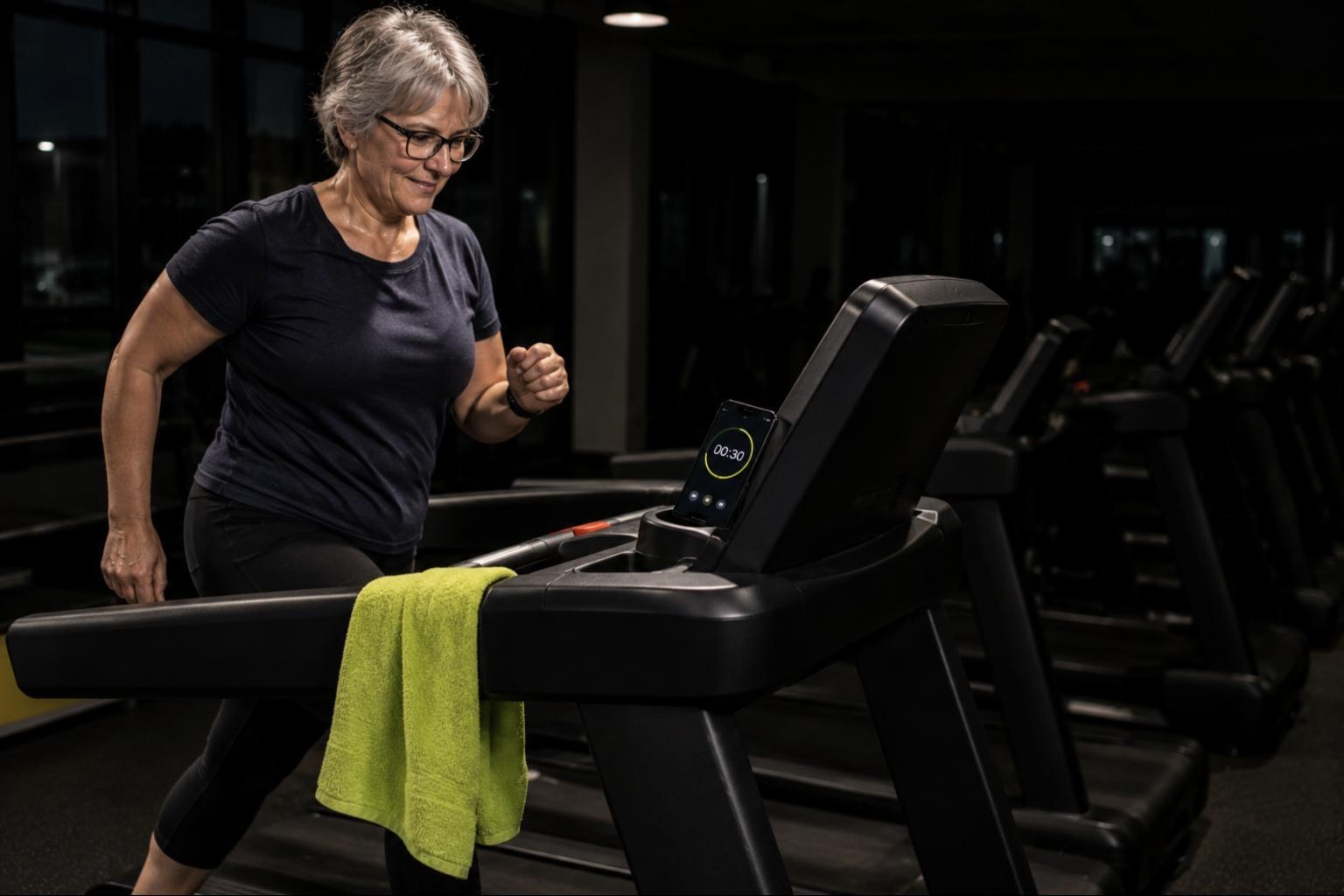
7. How much treadmill training do I need?
For general health, the NHS says adults should aim for at least 150 minutes of moderate activity a week, or 75 minutes of vigorous activity, spread across the week. Brisk walking counts as moderate. Running counts as vigorous.
The UK Chief Medical Officers add that shorter spells of very vigorous activity, such as sprinting, also count, and that a mix of moderate, vigorous and very vigorous activity works.
Three 25-minute walk-run sessions get you a good way there. Add some brisk walks on other days and you're close.
The guidelines also recommend activities that strengthen your major muscle groups on at least two days a week. Treadmill sessions don't cover that, so it's worth adding some strength work too.
8. What mistakes should beginners avoid?
A few common ones:
- Starting too fast. Your first work interval should feel almost too easy. You'll thank yourself by round five.
- Holding the handrails. A light touch for balance is fine. Leaning on them changes how you move.
- Skipping the warm-up. Five minutes of walking makes the first jog much less of a shock.
- Jumping on and off a moving belt. Slow the belt to a walk for your recovery spells instead.
- Doing intervals every day. Easy days matter. Mix intervals with walks.
If you have a heart condition, are pregnant, are recovering from an injury or illness, or haven't exercised for a long time and are worried, speak to your GP before you start.
Do I need an app for this?
Counting seconds while you're out of breath is hard. Glancing at the treadmill clock, doing maths, and missing the switch is very common.
A timer that tells you when to change makes a big difference. Good options:
- NHS Couch to 5K is free, and walks you through a 9-week walk-run plan. If you want a plan chosen for you, start here.
- Seconds Interval Timer (Runloop) is free to download with a paid upgrade. It has a colour-coded full-screen display, voice cues, haptics and an Apple Watch app.
- The Workout app on Apple Watch lets you build a custom workout with timed work and recovery intervals. Nothing extra to install if you already have a watch.
How Reptyl helps
Reptyl Timer is our interval timer for iPhone, and treadmill sessions are what it was built around.
- Ready-made treadmill timers, including 30/30, a pyramid and 4 × 4, so there's nothing to set up while you're on the belt.
- Time to slow down. Treadmill timers give you a few seconds to bring the belt down before the rest starts, so your walk really is a walk.
- Colour and a buzz. Every change fills the screen with colour and buzzes the phone. Sound is optional.
- Your own timers. Save the walk-run session above as your own timer, with its own labels, and it's ready next time.
It's a one-off purchase with no subscription, no account and no adverts, and your data stays on your phone. The Timer page has the details.
Once walk-run feels easy, try Tabata vs HIIT for harder sessions, or read the interval timer basics.
Quick answers
How long should a beginner treadmill interval workout be?
About 20 to 30 minutes including warm-up and cool-down is a sensible start. The work part might only be 6 to 8 minutes in total.
Is walking on a treadmill with intervals still worth it?
Yes. Brisk walking counts as moderate activity in the NHS guidelines. Alternating faster walking or incline walking with easier walking is a good interval session in its own right.
How many times a week should I do treadmill intervals?
Three times a week, with rest days in between, is how the NHS Couch to 5K plan works. It's a good pattern to copy.
For harder short-burst sessions, see what a Tabata workout is and how to time it.
Want a treadmill timer you can see and feel? See Reptyl Timer
Sources
- NHS: Physical activity guidelines for adults aged 19 to 64
- GOV.UK: UK Chief Medical Officers' physical activity guidelines
- NHS: Get running with Couch to 5K
- Jones and Doust (1996): A 1% treadmill grade most accurately reflects the energetic cost of outdoor running (record)
- App Store: Seconds Interval Timer
- Apple: Create a custom workout on Apple Watch