GuidesStrength training
How long should you rest between sets?
How long to rest between sets for muscle and strength: what the research says, rest times for big lifts and small exercises, and how to stop rest creeping up.
You finish a set, sit down, check your phone, and somehow it's been six minutes. For building muscle, rest about 1.5 to 2 minutes between most sets, and 2 to 3 minutes or more on heavy squats, deadlifts and presses. For pure strength on big lifts, 3 to 5 minutes is normal.
In short
- For muscle, rest at least 60 to 90 seconds. A 2024 review found a small benefit to resting more than 60 seconds, and little extra beyond 90.
- For heavy compound lifts, rest 2 to 3 minutes or more, so the next set is still good.
- Time your rest. Guessing usually means rushing the hard sets and dawdling on the easy ones.
1. How long should I rest between sets to build muscle?
At least a minute and a half on most exercises.
In 2024, Alec Singer, Brad Schoenfeld and colleagues pooled the studies that compared rest times for muscle growth. They found a small benefit to resting longer than 60 seconds, and no clear extra benefit from resting longer than 90 seconds. The results varied a lot between studies, so treat these as guide numbers, not hard rules.
The American College of Sports Medicine (ACSM) position stand suggests 1 to 2 minutes for muscle-building work in beginners and intermediate lifters, and 2 to 3 minutes for heavy core exercises in advanced lifters.
Put together:
- Small exercises (curls, lateral raises, cable work): about 60 to 90 seconds.
- Most machine and dumbbell work: about 90 seconds to 2 minutes.
- Heavy squats, deadlifts, presses and rows: 2 to 3 minutes, sometimes more.
2. Why does short rest hold back muscle growth?
Mainly because you do less work.
If you rest 45 seconds between heavy sets, your reps drop on the next set, so your total weight lifted over the session falls. The 2024 review suggests this drop in work is likely to be the reason shorter rest gives slightly less growth.
A 2016 study by Schoenfeld and colleagues in trained men found that resting 3 minutes rather than 1 minute led to bigger strength gains, and more growth in the front of the thigh, over eight weeks, with the same sets and reps.
So the "short rest for the pump" idea doesn't hold up well. Rest long enough that the next set is still hard and still heavy.
3. How long should I rest for strength?
Longer. Strength work uses heavier weights and fewer reps, and the quality of each rep matters more.
The ACSM suggests:
- At least 2 to 3 minutes between sets on core lifts with heavy loads.
- 1 to 2 minutes may be enough on assistance exercises.
- 3 to 5 minutes is common for intermediate and advanced strength training.
If you're working up to a heavy triple or a single, resting 4 or 5 minutes is normal, not lazy.
4. How do I know if I've rested enough?
Ask one question: will the next set be good?
Signs you need more rest:
- your reps drop by three or more from the last set
- your breathing hasn't settled before you pick up the bar
- your form breaks down earlier than it did on set one
Signs you're resting too long:
- you've cooled down and the first rep feels stiff
- your session is taking twice as long as planned
- you've lost focus and you're scrolling
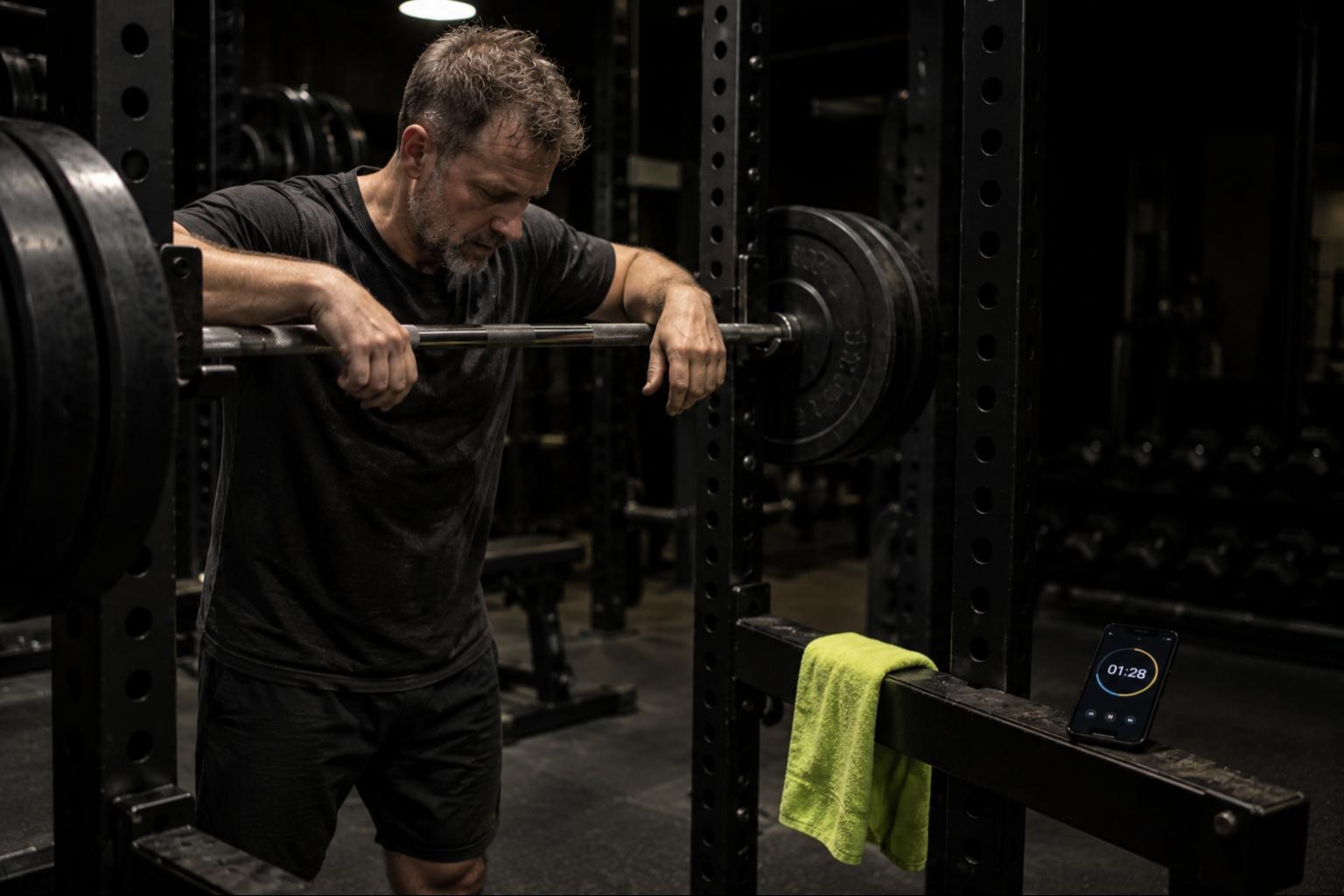
A good habit, from us: decide the rest before the set, start a timer when you rack the bar, and go when it ends.
5. Does it matter how close to failure I go?
A little. The harder the set, the longer you'll need to recover.
The 2024 review found that taking sets to failure, or stopping short, didn't meaningfully change the effect of rest time. In practice, though, a set taken to all-out failure usually needs more rest before the next one is any good.
Most lifters stop most sets with 1 to 3 reps left, which keeps rest times manageable. See how many sets and reps to build muscle.
6. Can I save time without cutting rest?
Yes. A few common ways:
- Supersets of opposite muscles. Do a set of rows, rest a minute, do a set of presses, rest a minute. Each muscle gets two minutes, but the clock only runs once.
- Fewer, harder sets. Cut the junk sets rather than the rest.
- Train more often. Four shorter sessions instead of three long ones. Our 4-day gym split does this.
- Warm up while you rest. Load the next bar or set up the next machine during the last 30 seconds.
Avoid supersets that hit the same muscle twice in a row if you want both sets to be good.
7. Is rest between sets the same as rest in HIIT?
No. In lifting, rest is there so the next set is good. In HIIT, the short rest is part of the training effect, and you're meant to start the next round not fully recovered.
That's why a Tabata uses just 10 seconds' rest. See Tabata vs HIIT and interval timer basics.
8. Anything else to check?
If you feel dizzy, sick or get chest pain between sets, stop and get advice. If you have a heart condition or high blood pressure, are pregnant, or are coming back from an injury, speak to your GP or a qualified instructor before heavy lifting.
The UK Chief Medical Officers recommend strength activities on at least two days a week. Good rest just makes those sessions count.
How Reptyl helps
Two Reptyl apps time your rest for you.
- Reptyl Sets & Reps starts a rest timer after each set you log, shows your numbers from last time, and gives a new best a banner. It also shows your weekly sets per muscle group.
- Reptyl Workout follows your plan one exercise at a time. Between sets, a rest countdown fills the screen, then it flashes and buzzes.
Both are one-off purchases with no subscription and no adverts. See the Sets & Reps page and the Workout page.
Quick answers
Is 60 seconds rest enough to build muscle?
It works, but a 2024 review found a small benefit to resting longer than 60 seconds. Around 90 seconds to 2 minutes is a better default for most exercises.
Is 3 minutes rest too long?
Not for heavy compound lifts. The ACSM suggests at least 2 to 3 minutes on heavy core exercises, and 3 to 5 minutes is common for strength work.
Should I rest longer on squats than curls?
Yes. Big lifts that use lots of muscle and heavy weights need more recovery than small exercises like curls or lateral raises.
Does resting longer burn fewer calories?
Slightly, per minute in the gym. But if longer rest lets you lift more, it's a better trade for muscle and strength.
Want a rest timer that starts itself? See Reptyl Sets & Reps
Sources
- Singer et al. (2024): Give it a rest: a systematic review with Bayesian meta-analysis on the effect of inter-set rest interval duration on muscle hypertrophy (Frontiers in Sports and Active Living)
- Schoenfeld et al. (2016): Longer interset rest periods enhance muscle strength and hypertrophy in resistance-trained men (DOI)
- ACSM (2009): Progression models in resistance training for healthy adults (abstract, Europe PMC)
- GOV.UK: UK Chief Medical Officers' physical activity guidelines