GuidesTraining basics
What is a Tabata workout, and how do you time it?
What a Tabata workout is, where the 20 seconds on, 10 seconds off format came from, how to time 8 rounds, and how to make it work for you.

Twenty seconds on, ten seconds off, eight times. A Tabata is only four minutes long, which is why it's so popular, and why it's so easy to get the timing wrong.
In short
- A Tabata is 8 rounds of 20 seconds hard work and 10 seconds rest: 4 minutes in total.
- It comes from a 1996 study on a bike, at an intensity most of us will never reach. Most gym "Tabatas" are a gentler version, and that's fine.
- You need a timer. Ten seconds is gone before you've wiped your face.
1. What is a Tabata workout?
A Tabata is a type of interval training with a fixed pattern:
- 20 seconds of hard work
- 10 seconds of rest
- repeated 8 times
That's 4 minutes. CrossFit's glossary describes it the same way: 8 intervals of 20 seconds of work followed by 10 seconds of rest.
You can do it with almost any exercise: squats, burpees, mountain climbers, a rowing machine, an exercise bike. Some people do one Tabata as a finisher at the end of a session. Others string several together with a minute or two of rest between them.
2. Where does the name Tabata come from?
From Professor Izumi Tabata and his colleagues in Japan. In 1996 they published a study in Medicine and Science in Sports and Exercise.
In it, people trained on an exercise bike in the lab. The hard part was 20-second bouts at about 170% of their VO2max, with 10 seconds of rest between bouts. After six weeks, their anaerobic capacity (roughly, how much hard work they could do in a short burst) went up by 28%, and their aerobic fitness rose too.
That 170% matters. It's far beyond a comfortable effort. In an article for the American Council on Exercise, trainer Jonathan Ross describes the original as seven to eight sets, and points out that most people will never work at that level. He suggests calling the gentler gym version "Tabata-inspired" instead.
So when a class calls something a Tabata, it usually means the timing, not the lab intensity.
3. How do I time a Tabata?
Set it up before you start. Once you begin, you won't want to think.
- Warm up for 5 to 10 minutes. Light cardio, then a few easy reps of your chosen exercise.
- Set your timer: 20 seconds work, 10 seconds rest, 8 rounds.
- Add a short countdown (5 or 10 seconds) so you can get into position.
- Go. Work for 20 seconds. Stop and breathe for 10.
- After round 8, walk around for a few minutes to cool down.
If you're doing more than one Tabata in a session, add a rest block between them. One or two minutes is common.
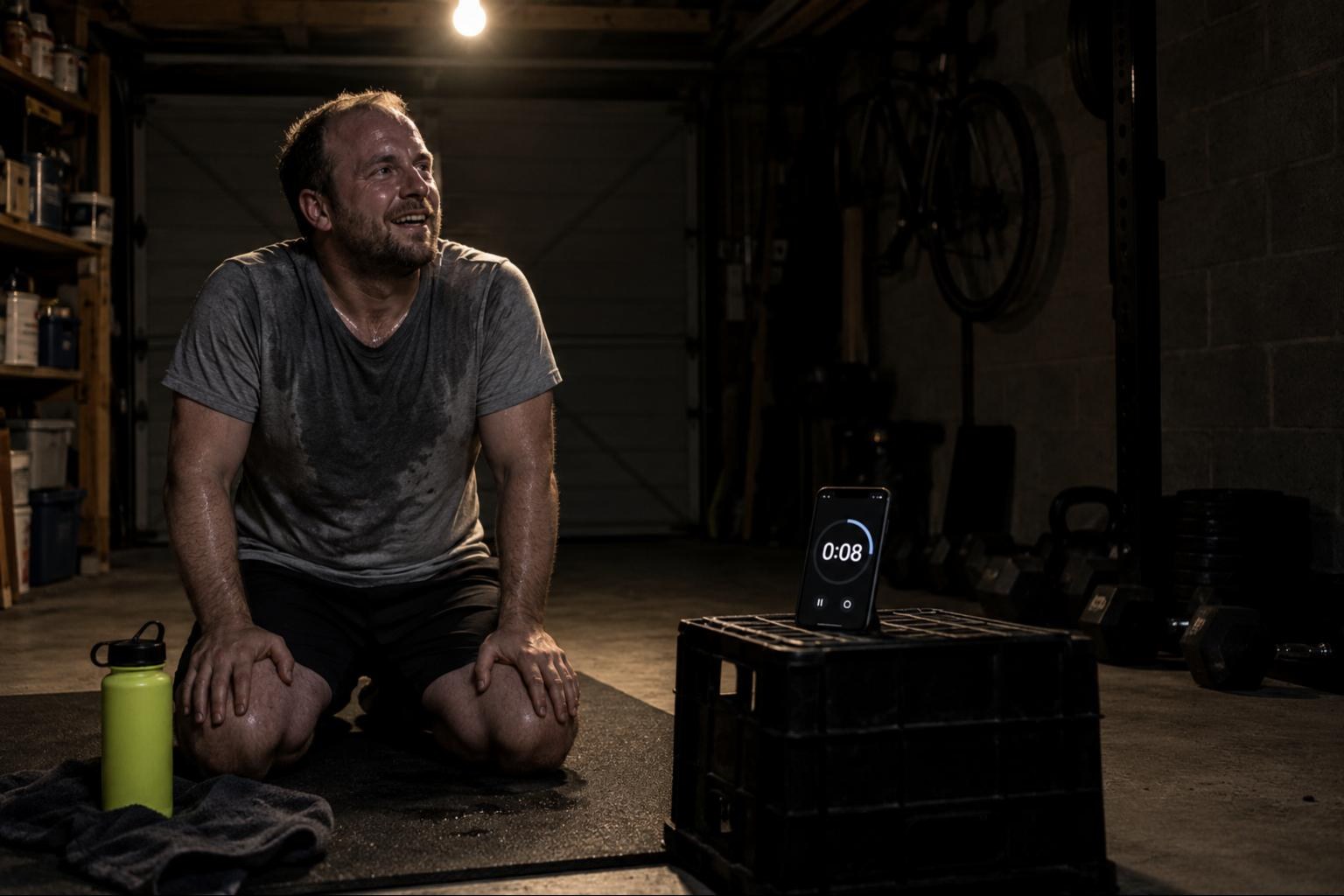
Total time for one Tabata, plus warm-up and cool-down: about 15 minutes. Have a drink of water and a towel within reach before you start, because you won't want to go looking for them in the 10-second rests.
4. Can I do a Tabata with a normal stopwatch?
You can, but it's fiddly.
You'd be watching for 0:20, 0:30, 0:50, 1:00, 1:20, and so on, all while out of breath. Most people lose count by round four.
Some people set a phone timer for 4 minutes and count rounds on their fingers. It's better than nothing. An interval timer that does the switching for you is much easier, and many are free.
5. What exercises work well for a Tabata?
Pick something that's safe to do quickly and simple to start and stop. Good choices:
- Bodyweight squats
- Mountain climbers
- Fast step-ups on a low step
- Exercise bike or rowing machine
- Plank shoulder taps for a core-focused round
Avoid heavy lifts or anything technical. When you're tired, form slips, and 20 seconds of messy deadlifts isn't worth the risk.
You can also alternate two exercises: squats in odd rounds, mountain climbers in even rounds. That gives each muscle group a little more rest.
6. How hard should a Tabata feel?
Hard, but under control.
The NHS talk test is a useful guide: at vigorous intensity, you can't say more than a few words without pausing for breath. For a Tabata, your work spells should feel at least that hard. The UK Chief Medical Officers call short bursts like this "very vigorous" activity.
By round six or seven, you should be struggling to keep the same pace. If you could chat through round eight, push a little more next time. If you're dizzy, feel sick, or have chest pain, stop.
If you're new to exercise, have a heart condition, are pregnant, or are coming back from an injury, speak to your GP first, or start with longer, gentler intervals.
7. What's an easier version for beginners?
You don't have to start at 20/10. The rest is very short on purpose.
Some easier options:
- Longer rest: 20 seconds work, 20 seconds rest, 8 rounds.
- Fewer rounds: 20/10 but only 4 rounds, then build up.
- Lower impact: marching on the spot or step-ups instead of jumping.
Once those feel manageable, move to the full 20/10 for 8 rounds. For walking and jogging intervals, see our guide to treadmill interval workouts for beginners.
8. How often should I do Tabata workouts?
Short, very hard sessions take more recovery than a steady walk. Two or three a week, on non-consecutive days, is plenty for most people.
For general health, the NHS recommends at least 150 minutes of moderate activity or 75 minutes of vigorous activity a week, plus strength work on two days. The UK Chief Medical Officers say shorter spells of very vigorous activity count too. A few Tabatas can be part of that, alongside walking, cycling or anything else you enjoy.
Do I need an app for this?
A Tabata lives or dies by its timing. Ten seconds of rest really is ten seconds, and missing the switch throws off every round after.
Good options:
- Seconds Interval Timer (Runloop) is free with an optional upgrade. It has a colour-coded full-screen display you can read from across the room, voice cues, haptics and a watch app.
- The Workout app on Apple Watch lets you create a custom workout with timed work and recovery intervals. If you already have a watch, it costs nothing.
- Gym and class timers. Many gyms have a big wall clock with interval settings. Ask at the desk.
How Reptyl helps
Reptyl Timer is our iPhone interval timer, and a 20/10 Tabata is one of its ready-made timers.
- Tabata, EMOM and plank sets are built in. Pick one and press start.
- Colour and a buzz. Each change fills the screen with colour and buzzes the phone, so you know when to switch without hearing anything.
- Carries on if the app closes. Lock the phone and it still buzzes at each change. If iOS closes the app, the run opens again at the right point.
- Your own timers. Save the easier 20/20 version, or four rounds instead of eight, and keep it for next time.
It's a one-off purchase with no subscription, no account and no adverts, and your data stays on your phone. The Timer page has the details.
Not sure whether you want a true Tabata or a longer HIIT session? Read Tabata vs HIIT.
Quick answers
How long is a Tabata workout?
One Tabata is 4 minutes: 8 rounds of 20 seconds work and 10 seconds rest. With a warm-up and cool-down, allow about 15 minutes.
Is Tabata the same as HIIT?
Tabata is one type of HIIT (high-intensity interval training). HIIT is the wider family. It covers any pattern of short hard efforts with rest, such as 30/30 or 40/20.
Can I do a Tabata every day?
It's better not to. Very hard sessions need recovery. Two or three a week on non-consecutive days, with easier activity in between, is a sensible pattern for most people.
Is a 4-minute Tabata enough exercise?
On its own, it's a short session. It works well as a finisher, or as two to four Tabatas with rests between them. Count it towards your weekly activity, rather than relying on it alone.
Want a Tabata timer you can see and feel? See Reptyl Timer
Sources
- Tabata et al. (1996): Effects of moderate-intensity endurance and high-intensity intermittent training on anaerobic capacity and VO2max (abstract, Europe PMC)
- ACE: Everything you need to know about Tabata training (Jonathan Ross)
- CrossFit: CrossFit terms explained
- NHS: Physical activity guidelines for adults aged 19 to 64
- GOV.UK: UK Chief Medical Officers' physical activity guidelines
- Apple: Create a custom workout on Apple Watch
- App Store: Seconds Interval Timer