GuidesFood and drink
How much protein do I need a day? UK guidance
How much protein do you need? UK guidance is 0.75g per kg of body weight for adults. How to work out yours, what active people need, and good food sources.

UK guidance is 0.75 g of protein per kg of body weight a day, which is about 56 g for a 75 kg man and 45 g for a 60 kg woman. If you train hard, sports bodies use 1.2 to 2.0 g per kg. Protein shakes, protein bars, "high protein" yoghurt: it's easy to think you're short of it, but most people in the UK already eat more than the basic figure.
In short
- UK guidance for adults is 0.75 g of protein per kg of body weight a day. That's roughly 56 g for a 75 kg man and 45 g for a 60 kg woman.
- The British Nutrition Foundation says most UK adults already eat more than that.
- Very active people may need more, and the BNF says that's better coming from food than supplements.
1. How much protein do I need a day?
The British Nutrition Foundation (BNF) explains that the UK recommendation for adults is based on 0.75 g of protein per kilogram of body weight a day.
The BNF gives the current recommendations as:
- Men: 56 g a day (based on a body weight of 75 kg)
- Women: 45 g a day (based on a body weight of 60 kg)
The BNF also notes that average body weights are probably higher now than when these figures were set, which is a good reason to work out your own number.
2. How do I work out my own protein needs?
Multiply your weight in kilograms by 0.75.
- Find your weight in kg. If you know it in stone, multiply stones by 6.35 (and add pounds × 0.45).
- Multiply by 0.75.
- That's your daily figure in grams.
Examples:
| Body weight | × 0.75 | Protein per day |
|---|---|---|
| 55 kg | × 0.75 | about 41 g |
| 65 kg | × 0.75 | about 49 g |
| 75 kg | × 0.75 | about 56 g |
| 85 kg | × 0.75 | about 64 g |
| 95 kg | × 0.75 | about 71 g |
This is a general reference for healthy adults. If you have a medical condition, including kidney problems, or you're pregnant, ask your GP or a registered dietitian what's right for you.
3. Am I eating enough protein already?
Probably.
The BNF reports that the average daily protein intake in the UK is 76 g for adults aged 19 to 64, and 67 g for adults aged 65 and over. Both are above the basic requirement for most people.
The biggest sources in the UK diet, according to the BNF, are meat and meat products (about a third) and cereals and cereal products such as bread (about a quarter).
4. Do I need more protein if I exercise?
You might, if you train hard.
The BNF says some people, such as athletes and older adults, may have higher protein requirements. It quotes two sports bodies:
- The International Olympic Committee: 1.2 to 1.8 g per kg of body mass a day for athletes.
- The American College of Sports Medicine: 1.2 to 2.0 g per kg a day.
These figures are for athletes in serious training, not for someone who goes to the gym twice a week.
If you lift seriously, a useful reference is a 2018 review by Robert Morton and colleagues of 49 studies on resistance training. Gains in muscle from extra protein levelled off at about 1.6 g per kg a day. For an 85 kg lifter, that's about 136 g, spread over the day.
The BNF also notes that total daily protein seems to matter more for building muscle than exact timing. After exercise, it says 20 to 25 g of high-quality protein seems sufficient.
For training advice, see how many sets and reps to build muscle.
5. Do I need protein shakes or supplements?
For most people, no.
The BNF says we don't need to add protein supplements or special products with added protein to our diets. For people doing intensive training, supplements may be convenient, but it says it's better to get protein from food where possible.
We don't recommend or sell any supplements.
6. What are good sources of protein?
The NHS Eatwell Guide says to eat some beans, pulses, fish, eggs, meat and other protein foods. It recommends at least two portions of fish a week, one of them oily, and eating less red and processed meat.
The BNF gives these examples of protein per 100 g:
| Food (per 100 g) | Protein |
|---|---|
| Chicken breast, grilled, skinless | 32.0 g |
| Cheddar cheese | 25.4 g |
| Almonds | 21.1 g |
| Tofu, steamed | 8.1 g |
| Red lentils, boiled | 7.6 g |
Remember that you rarely eat 100 g of cheese or almonds in one go, but you might easily eat 150 g of lentils.
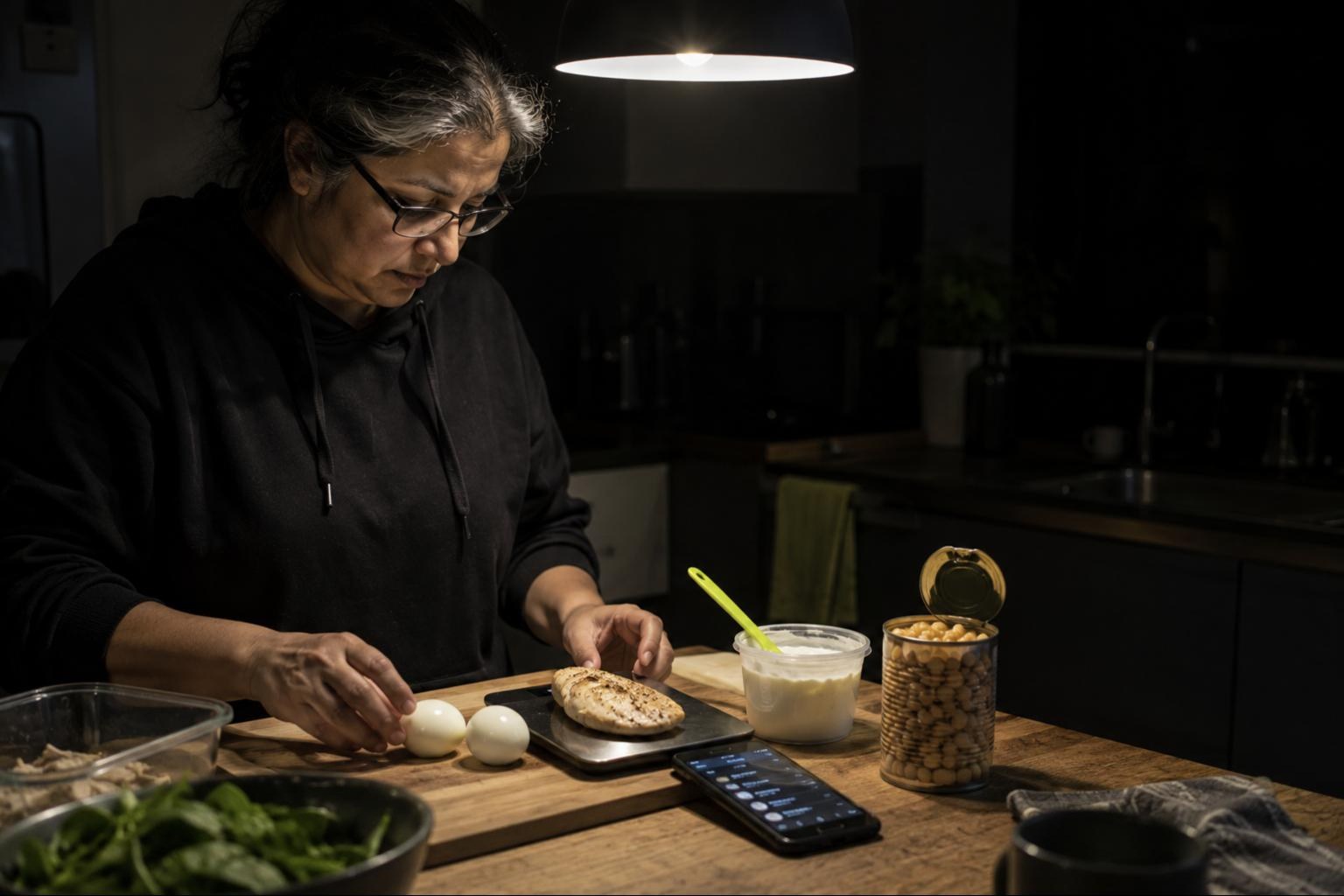
7. What does 50 g of protein look like?
Using the BNF's per-100 g figures, here's roughly what some everyday portions provide. The maths is ours.
| Portion | Protein |
|---|---|
| 100 g grilled chicken breast | about 32 g |
| 150 g boiled red lentils | about 11 g |
| 150 g steamed tofu | about 12 g |
| 30 g cheddar (a small matchbox-sized piece) | about 8 g |
| 30 g almonds (a small handful) | about 6 g |
A chicken breast at dinner and a cheese sandwich at lunch could take many adults close to their daily figure, before you count the bread, milk, cereal and other foods that also contain protein.
That's why most people in the UK don't need to think hard about protein.
8. Can I get enough protein on a plant-based diet?
Yes, with a little planning.
The BNF points out that pulses such as kidney beans, baked beans, chickpeas and lentils all provide plant-based protein. Tofu, nuts, seeds and cereals also contribute.
Eating a mix of these through the day makes it easier. If you're vegan and unsure whether you're getting what you need, a registered dietitian can help.
9. How do I spread protein across the day?
You don't need to count every gram. A simple habit is to include a protein food at each meal.
Some everyday examples:
- Breakfast: eggs on toast, yoghurt, or porridge made with milk
- Lunch: a tuna, chicken, egg or bean sandwich, or lentil soup
- Dinner: fish, chicken, tofu, beans or lean meat with vegetables
- Snacks: a handful of nuts, a glass of milk, or some cheese
If you want to check your intake for a few days, use food labels. Protein is listed in grams in the nutrition table, usually per 100 g and sometimes per portion.
Do I need an app for this?
For most people, protein looks after itself if meals include a protein food. Tracking it for a few days can help if you're curious, training hard, or eating a new way.
Free options:
- Food labels and a notebook. Write down the protein figure for what you eat for three or four days.
- Cronometer has a free version, with free barcode scanning.
- The NHS Weight Loss Plan app is free, though it's built around weight loss rather than protein.
For more on tracking without paying, see how to count calories without paying for an app.
How Reptyl helps
Reptyl Food builds your day around calories and protein, with no subscription.
- Day plans. Pick a day card and get a full day of meals built around your calories and protein. Swap any food on it.
- Plan the week. Give each day a card, or leave a day free for eating out.
- Meal deals. Tesco meal deals and sandwiches with values per pack, plus typical deals from other shops.
- Food from home. Regional Indian cuisines such as Gujarati, Punjabi and South Indian, and many more, with rotis and rice by the portion.
It's a one-off purchase with no subscription, no account and no adverts, and your data stays on your phone. The Food page has the details.
Vegetarian? Read Gujarati vegetarian high-protein meals. Eating on the go? See high-protein Tesco meal deal picks.
Quick answers
How much protein do I need to build muscle?
The BNF quotes the American College of Sports Medicine's range of 1.2 to 2.0 g per kg a day for athletes. Many people who lift recreationally already eat more than the basic 0.75 g per kg. Total daily protein seems to matter more than timing.
Is 100 g of protein a day too much?
It's well above the basic UK requirement for most adults. Whether it suits you depends on your size, how active you are and your health. If you have a medical condition, especially a kidney condition, speak to your GP or a registered dietitian before deliberately eating a lot more protein.
How much protein does an older adult need?
The BNF notes that older adults may have higher protein needs than younger adults. If you're worried about an older relative's eating, speak to their GP.
Want to hit your protein without guessing? See Reptyl Food